Animations
Copyright: The material on this page is the property of Matthew Bate.
Any of my pictures and animations may be used freely for non-profit
purposes (such as during scientific talks) as long as appropriate
credit is given wherever they appear. Permission must be obtained
from me before using them for any other purpose (e.g. pictures for publication
in books).
Simulation & visualisation by Matthew Bate, University of Exeter unless stated otherwise.
Notes on formats:
AVI: Plays directly in Powerpoint. Medium to high quality, smallest file sizes.
Quicktime: Plays directly in Powerpoint only on an Apple computer. Can be played under Windows by downloading the FREE Quicktime player from Apple. Can be played under Unix/Linux using xanim. Highest quality, large file sizes.
| |
 | |
Movie showing the full evolution of the system, 94 seconds. Small file size, specifically for downloads by modem. Same as 94 second animation below, but smaller format (400x400 pixels) and without scientific annotations.
Available formats for 94 second animation:
AVI for Windows, Mac, or Unix (32MB, medium quality)
|
| |
 | |
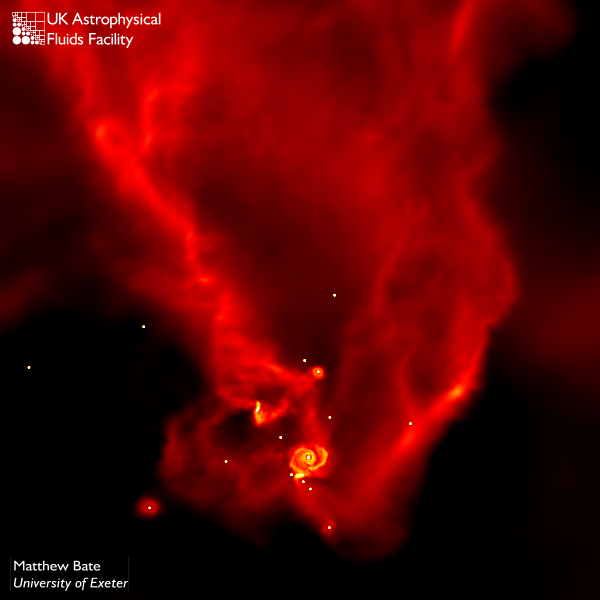
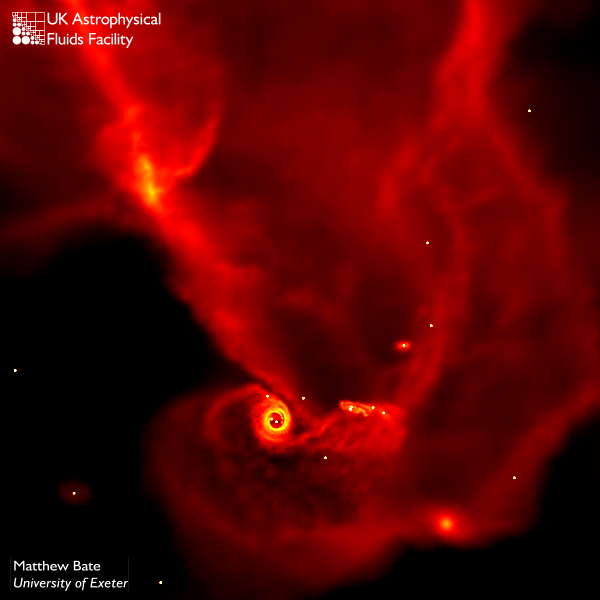
Movie showing the full evolution of the system. Two versions, 94 seconds and 163 seconds, the latter of which shows the star formation sequence twice. Specifically for scientific talks with annotations giving the time (yrs), size (AU), and column density scale (g/cm2) during the animation. Both use 600x600 pixel frames.
Available formats for 94 second animation:
AVI for Windows, Mac, or Unix (56MB, medium quality)
AVI for Windows, Mac, or Unix (172MB, high quality)
Quicktime for Powerpoint on a Mac, or Quicktime on Windows, or xanim on Unix (286MB, highest quality)
Available formats for 163 second animation:
AVI for Windows, Mac, or Unix (94MB, medium quality)
AVI for Windows, Mac, or Unix (288MB, high quality)
Quicktime for Powerpoint on a Mac, or Quicktime on Windows, or xanim on Unix (486MB, highest quality)
|
| |
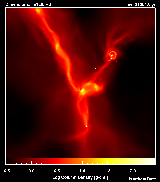 | |
Shorter (71 second) clip showing only the details of the star formation. Specifically for scientific talks with annotations giving the time (yrs), size (AU), and column density scale (g/cm2) during the animation. 600x600 pixel frames.
Available formats:
AVI for Windows, Mac, or Unix (39MB, medium quality)
AVI for Windows, Mac, or Unix (109MB, high quality)
Quicktime for Powerpoint on a Mac, or Quicktime on Windows (254MB, highest quality)
|
| |
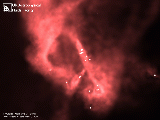 | |
A fly-through of the later stages of the evolution
of the star cluster, showing the details of some of the star systems and
proto-planetary discs. This animation was produced by Richard West
(UKAFF) and is available via
UKAFF's mirror site.
Available formats:
AVI for Windows or Mac (57MB, high quality)
AVI for Unix (138MB, high quality)
Simulation Matthew Bate, University of Exeter
Visualisation Richard West, UKAFF.
|
Press Release Text (Embargoed for Friday April 12, 2002)
YOUNG STARS IN CHAOS
It is not only teenagers who like to congregate in intimate groups and
disturb their neighbours and surroundings.
As Matthew Bate (University of Exeter), will be explaining to the UK National
Astronomy Meeting in Bristol on Friday 12 April, young stars also like to
hang around in crowds and undergo chaotic close encounters with each other
during their formative years.
After performing one of the largest and most complex simulations of star
formation to date, Matthew Bate, Ian Bonnell (University of St Andrews) and
Volker Bromm (Harvard-Smithsonian Center for Astrophysics) have found that
these cosmic furnaces form in a much more chaotic manner than is generally
believed.
To perform the calculation, the astronomers used the supercomputer at the
United Kingdom Astrophysical Fluid Facility (UKAFF), a national computing
facility for astronomy sited at the University of Leicester. The calculation
was so enormous that it required 100,000 CPU hours, roughly 10% of the time
available on the 128-processor supercomputer during 2001.
The simulation followed the collapse of an interstellar gas cloud which was
over one light year across and 50 times the mass of the Sun, eventually
resulting in the formation of a cluster of 50 stars and brown dwarfs.
One of the big surprises found by the astronomers was how chaotic and dynamic
the process of star formation is. The results showed that stars form so close
together that they often interact with each other well before they have grown
to full size.
In the small, new-born stellar groups, the stars compete with each other for
the remaining gas. This process is inherently unfair, with the more massive
stars tending to gather more gas than the lower mass stars, while the lowest
mass stars are kicked out of the group.
About half of the objects are ejected so quickly that they don't manage to
gather enough gas to become stars at all. Rather, they become brown dwarfs,
objects with less than 1/13 the mass of the Sun. Unable to generate energy
by fusing hydrogen into helium, they cannot continue to shine like the Sun
and quickly fade away.
The new calculation supports recent astronomical surveys suggesting that
there may be as many brown dwarfs as stars in our Galaxy, and indicates that
the high frequency of brown dwarfs is a natural consequence of the
competition between stars during their formation.
Another surprise is that many of the encounters between the stars and brown
dwarfs in such clusters are close enough to strip off the outer parts of the
dusty discs surrounding the young stars. Although many of the discs are
initially very large, by the end of the calculation the majority of them have
been truncated to less than the size of our Solar System.
Since most stars are believed to form in large star clusters, this suggests
that planetary systems like our own may be the exception rather than the rule.
Technical Details
The calculation models the collapse and fragmentation of a 50 solar mass
molecular cloud that is 0.375 pc in diameter (approximately 1.2 light-years).
At the initial temperature of 10 K with a mean molecular weight of 2.46, this
results in an thermal Jeans mass of 1 solar mass. The free-fall time of the
cloud is 190,000 years and the simulation covers 266,000 years.
The cloud is given an initial supersonic `turbulent' velocity
field in the same manner as Ostriker, Stone & Gammie (2001).
We generate a
divergence-free random Gaussian velocity field with a power spectrum
P(k) \propto k-4, where k is the wave-number.
In three-dimensions, this results in a
velocity dispersion that varies with distance, lambda,
as sigma(lambda) \propto lambda1/2 in agreement with the
observed Larson scaling relations for molecular clouds (Larson 1981).
This power spectrum is slighly steeper than the Kolmogorov
spectrum, P(k)\propto k11/3. Rather, it matches the
amplitude scaling of Burgers supersonic turbulence associated
with an ensemble of shocks (but differs from Burgers turbulence
in that the initial phases are uncorrelated).
The calculation was performed using a parallel three-dimensional
smoothed particle hydrodynamics (SPH)
code with 3.5 million particles on the
United Kingdom Astrophysical Fluids Facility (UKAFF). It took approximately 100000 CPU hours running on up to 64
processors. In terms of arithmetic operations, the calculation required
approximately 1016
FLOP (i.e. 10 million billion arithmetic operations).
The SPH code was parallelised using OpenMP by M. Bate. The code uses
sink particles (Bate, Bonnell & Price 1995) to model condensed objects
(i.e. the stars and brown dwarfs). Sink particles are point masses that
accrete bound gas that comes within a specified radius of them. This
accretion radius is to set 5 AU. Thus, the calculation resolves circumstellar
discs with radii down to approximately 10 AU. Binary systems are followed
to separations as small as 1 AU.
Refereed Scientific Papers
"The Formation Mechanism of Brown Dwarfs"
Bate, M. R., Bonnell, I. A., Bromm, V., 2002, MNRAS, 332, L65-L68.
"The Formation of Close Binary Systems by Dynamical Interactions and Orbital Decay"
Bate, M. R., Bonnell, I. A., Bromm, V., 2002, MNRAS, 336, 705-713.
"The Formation of a Star Cluster: Predicting the Properties of Stars and Brown Dwarfs"
Bate, M. R., Bonnell, I. A., Bromm, V., 2002, MNRAS, in press.
High Resolution Still Images and Commentary
High resolution, unannotated (1800x1800 pixel) versions that are suitable for
publication
are available on request by emailing Matthew Bate
at: mbate @ astro.ex.ac.uk
Click on the images below to view medium resolution, annotated
(600x600 pixel) versions.
Copyright: Matthew Bate, University of Exeter.
 |
|
 |
|
 |
|
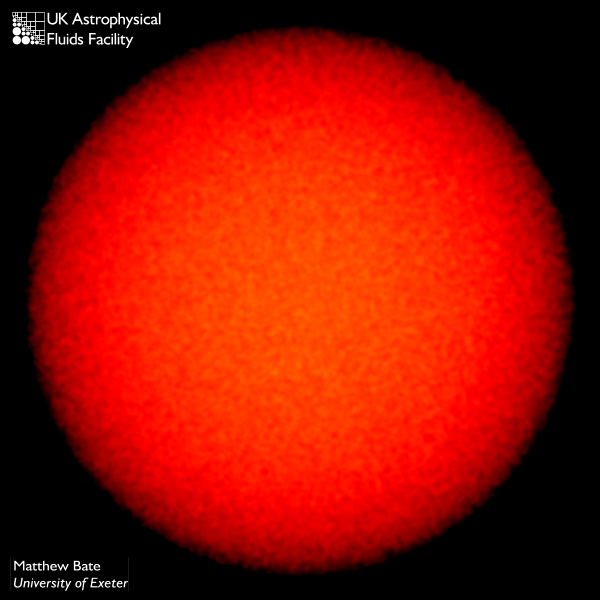
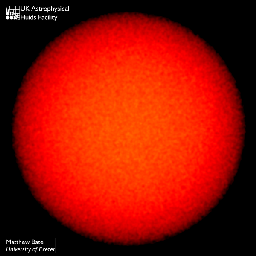
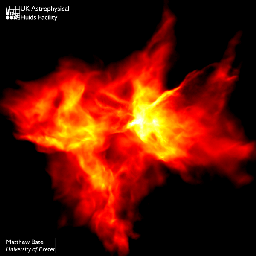
Clouds of interstellar gas are seen to be very
turbulent with supersonic motions. We begin with
such a gas cloud, 1.2 light-years across, and
containing 50 times the mass of the Sun.
|
|
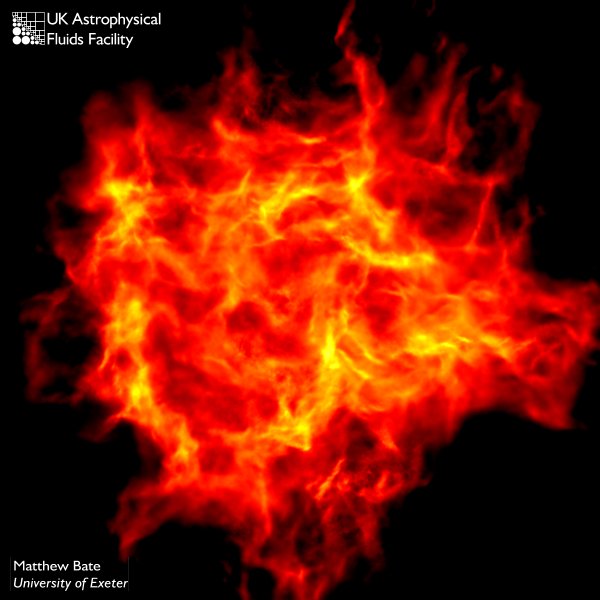
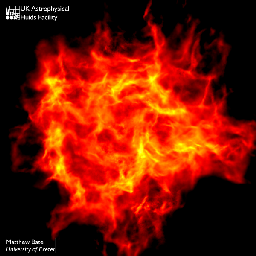
As the calculation proceeds, the turbulent motions
in the cloud form shock waves that slowly damp
the supersonic motions.
|
|
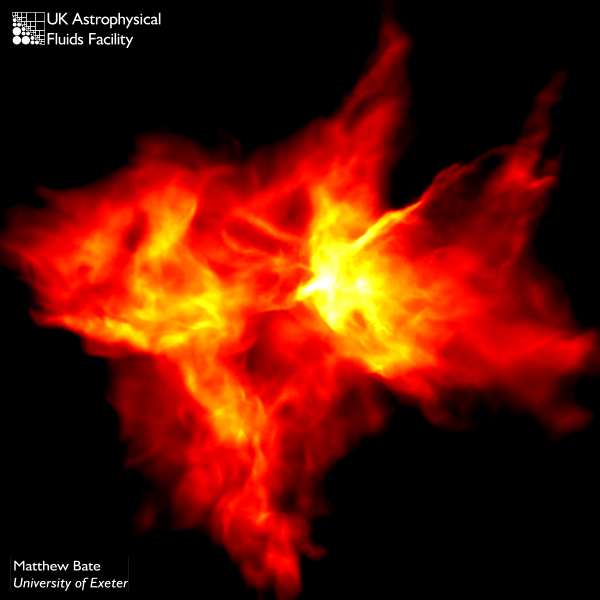
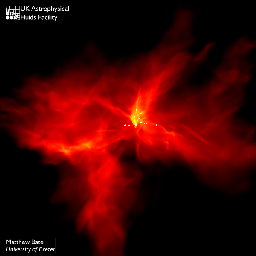
When enough energy has been lost in some
regions of the simulation, gravity can pull the gas
together to form a dense "core".
|
|
 |
|
 |
|
 |
|
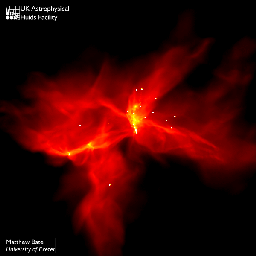
The formation of stars and brown dwarfs begins in
this dense core (see below).
|
|
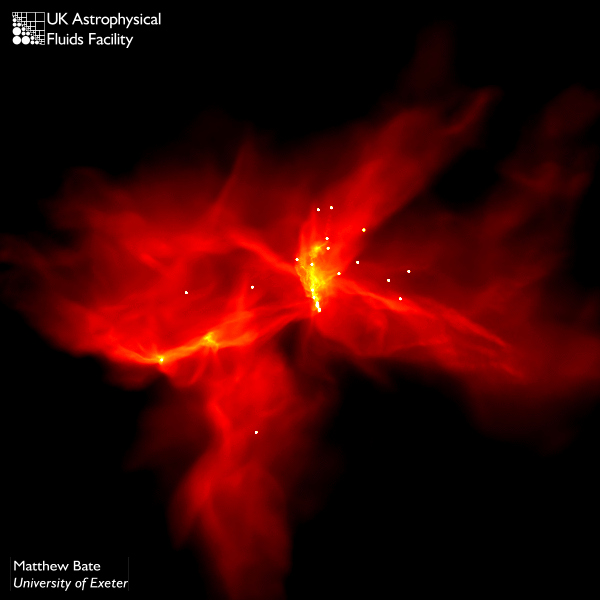
As the stars and brown dwarfs interact with each
other, many are ejected from the cloud.
|
|
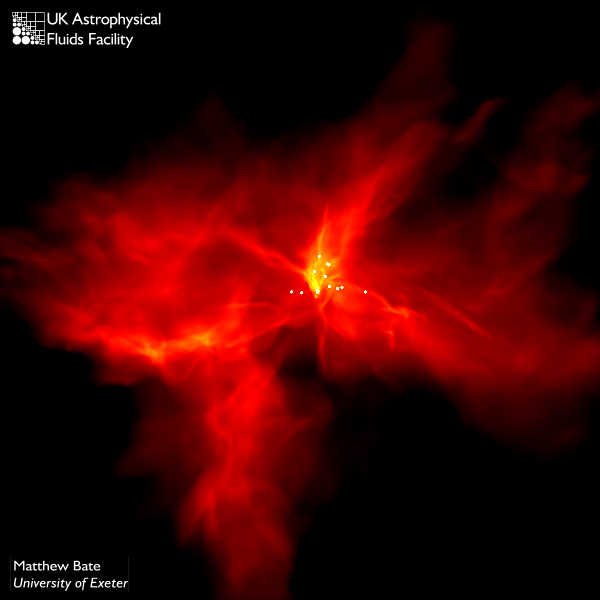
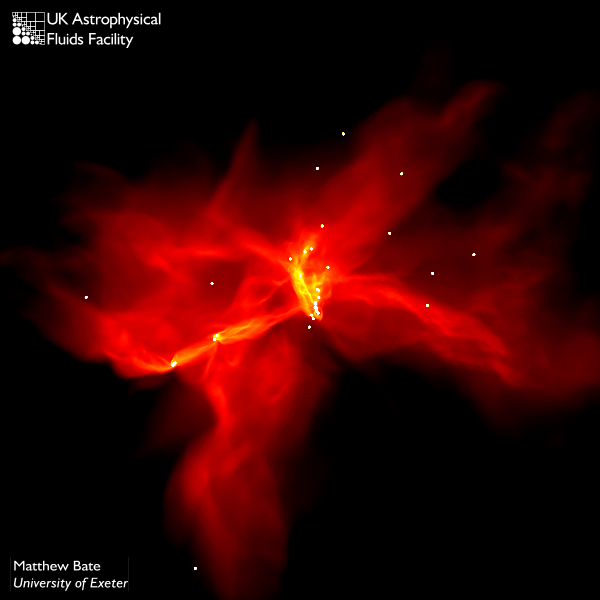
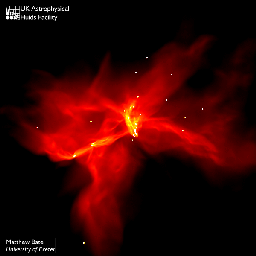
The cloud and star cluster at the end of simulation
(which covers 266,000 years). Some stars and brown
dwarfs have been ejected to large distances from the
regions of dense gas in which the star formation occurs.
|
|
 |
|
 |
|
 |
|
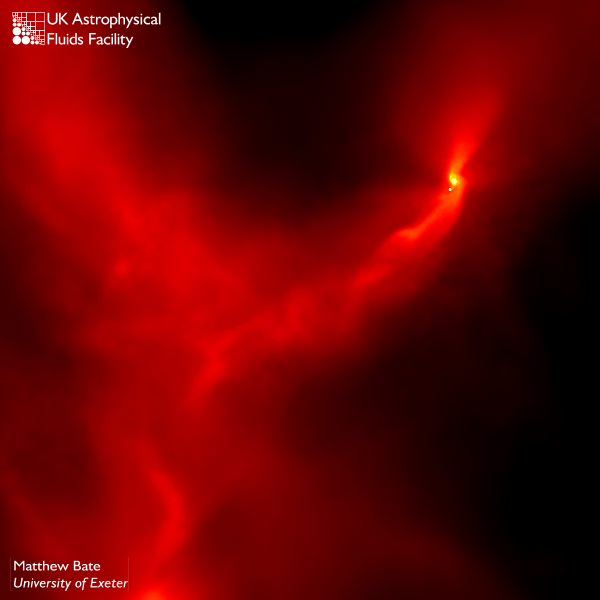
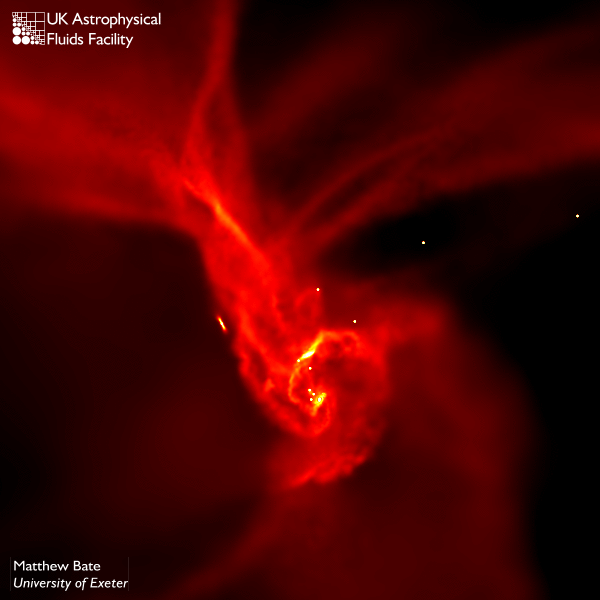
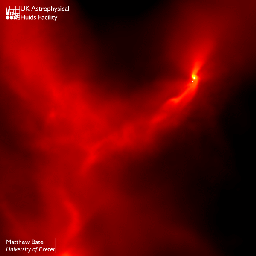
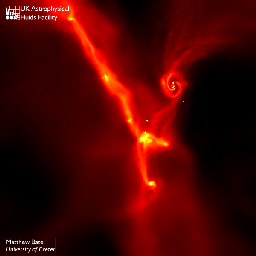
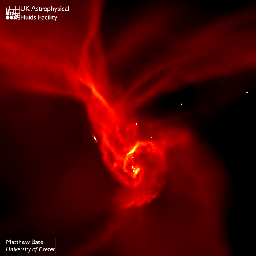
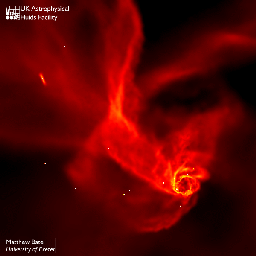
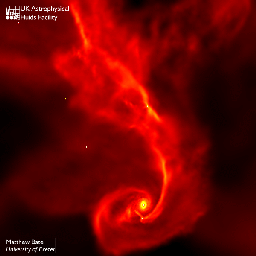
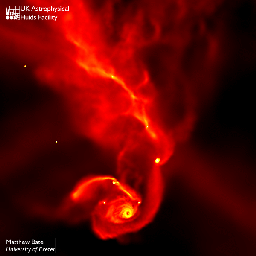
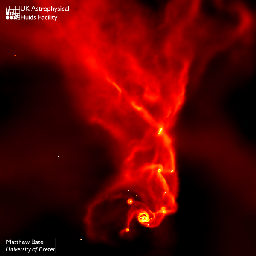
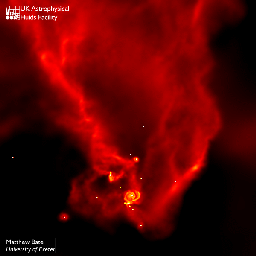
Nine images showing the star formation in detail.
They are 16 times smaller than the images above,
measuring 5100 AU across (1 AU is the distance
between the Earth and the Sun). Star formation
begins with the formation of a binary.
|
|
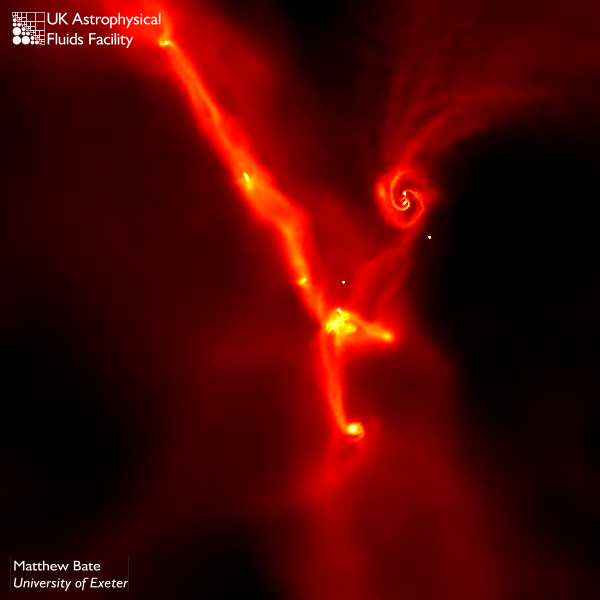
Gas filaments and discs form stars and brown
dwarfs. Some of the remaining gas falls in
around these protostars forming protoplanetary
discs and building up the masses of the protostars.
|
|
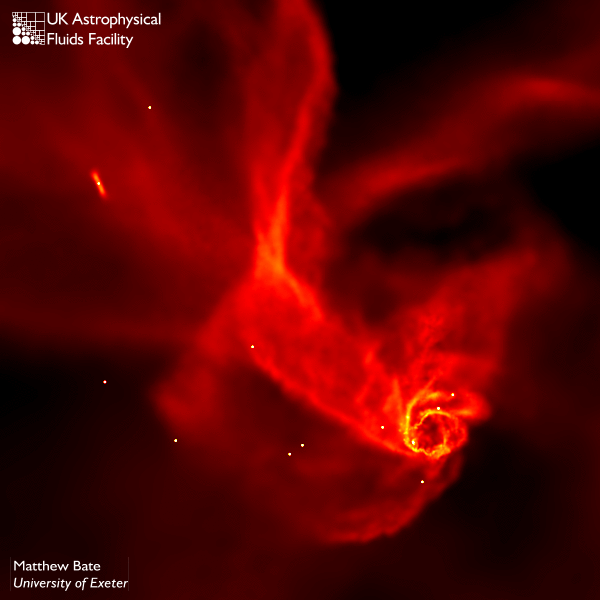
Stars and brown dwarfs fall together into a cluster.
The objects range in mass from nearly the mass of
the Sun down to as small as 6 times the mass of
Jupiter. A star with an edge-on disc is ejected,
centre left.
|
|
 |
|
 |
|
 |
|
An unstable system of 5 stars breaks up and
ejects stars from the cloud in three different
directions (lower right; see animations).
|
|
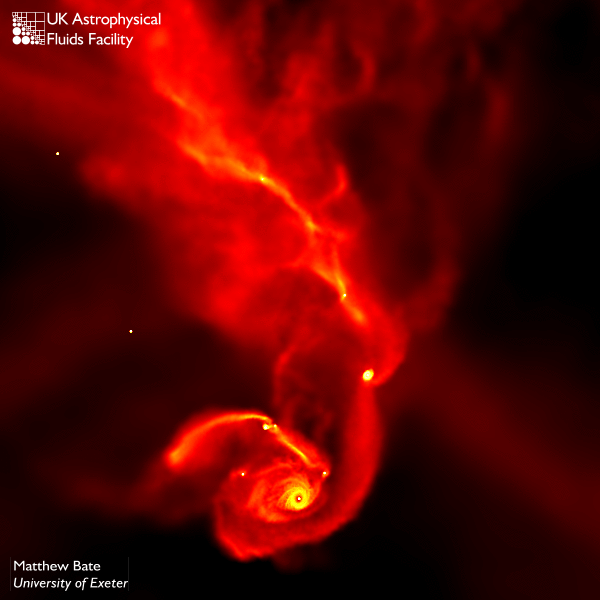
After a pause, star formation begins again with the
gathering together of more gas (centre). The discs
of gas that form around the protostars also contain
a lot of mass and gravity can also cause
protostars to form within these discs. For
example, around the first binary, 3 objects form,
and several form in the large disc in the image
above (bottom).
|
|
The orbits of these objects are unstable and they
are quickly ejected from the binary. Because they
are ejected from the dense gas just after they are
formed they are unable to increase their masses
by attracting the residual gas and they become
brown dwarfs with masses of less than 75 times
that of Jupiter. Other objects are able to attact
enough gas that they become proper stars.
|
|
 |
|
 |
|
 |
|
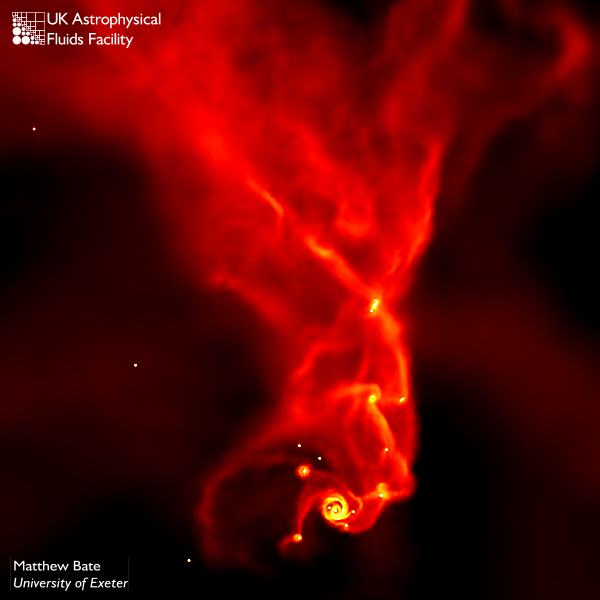
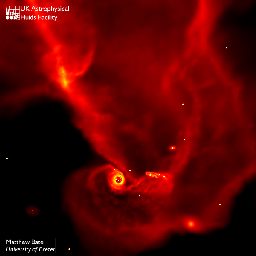
Complex gas flows and stellar encounters. Many
of the stars and brown dwarfs are surrounded by
discs which are truncated during encounters.
|
|
Brown dwarf with a large disc is ejected, lower left.
|
|
The stars and discs in the main star-forming
region at the end of the calculation.
|
|
 Matthew Bate's research
Matthew Bate's home page